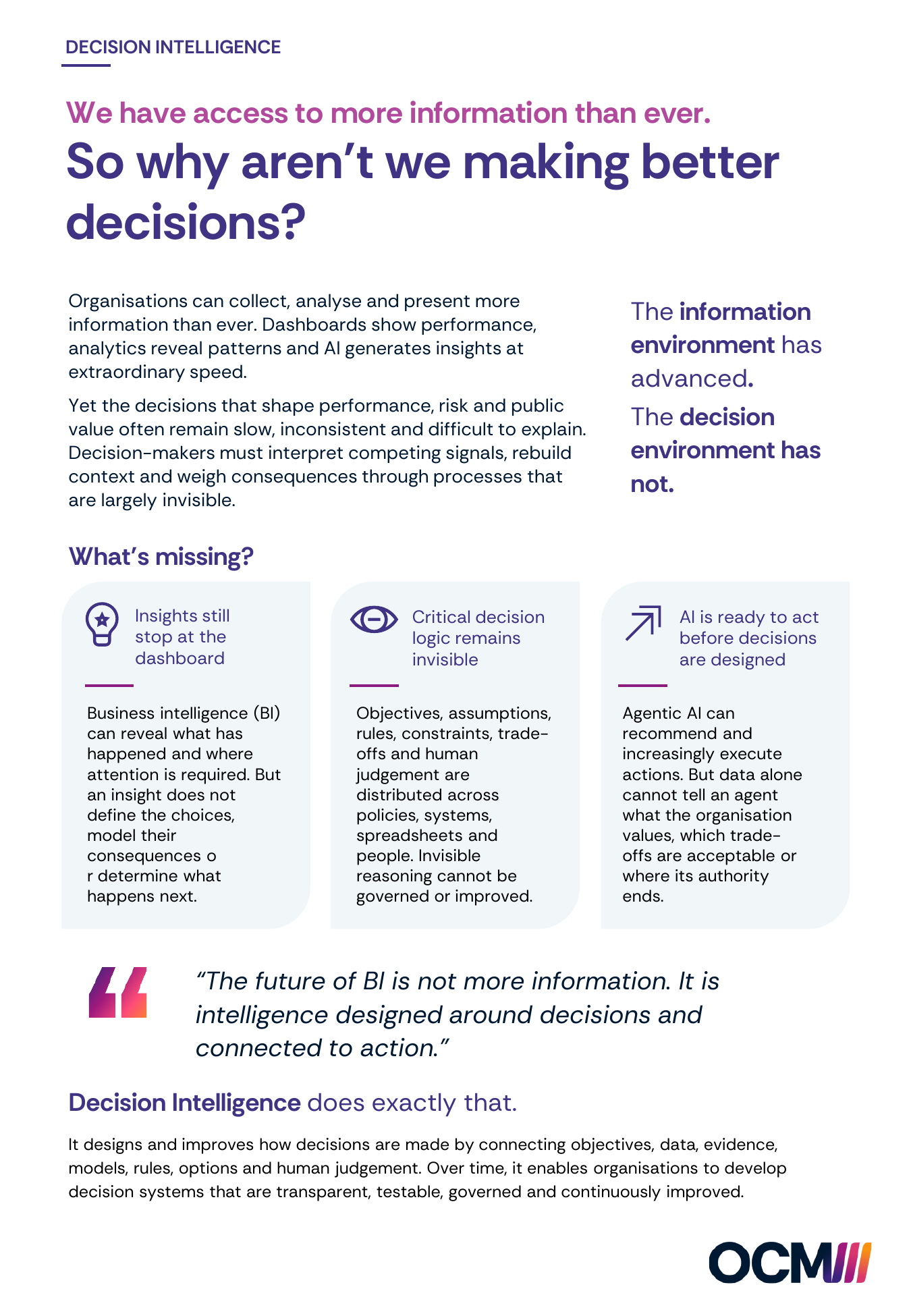
We have access to more information than ever.So why aren’t we making better decisions?
Dashboards explain performance. Analytics reveal patterns and can increasingly predict what may happen next. AI can find and synthesise information at extraordinary speed.
The information environment has advanced. The decision environment has not.
Decision Intelligence changes the starting point. We begin with the desired outcome, then work backwards to understand the decisions, levers, causal relationships, external influences, constraints and trade-offs that determine whether we achieve it.
Decision Intelligence is not another form of predictive analytics.
Traditional analytics usually starts with the information available. Decision Intelligence starts with the desired outcome and the decisions that can influence it.
Business Intelligence & analytics
Start with the information.
What happened?
What is happening?
Why is it happening?
What is likely to happen next?
Essential insight, but an insight does not define the choices, model their consequences or decide what should happen next.
Decision Intelligence
Start with the desired outcome.
What are we trying to achieve?
What decisions and levers can influence it?
What else affects the outcome?
How are those factors causally connected?
What assumptions, constraints and trade-offs matter?
What evidence supports what we believe?
The shift is from analysing the world as it is to deliberately modelling how our decisions can change it.
Make decision logic visible
Organisations already have decision systems. Most just cannot see them.
Objectives, assumptions, rules, constraints, trade-offs and human judgement are often distributed across policies, systems, spreadsheets and people. Invisible reasoning cannot be systematically challenged, governed or improved.
OCM uses techniques including Causal Decision Diagrams to create a shared representation of how a decision is believed to work.
The desired outcome becomes the anchor. We work backwards to identify the decisions and levers that can influence it, the intermediate impacts between action and outcome, and the external factors that can change the result.
Simplified illustration. A real world CDD is significantly more detailed, mapping the decisions, levers, influences, constraints, evidence and causal relationships that shape the desired outcome.
From causal model to intelligence
Once the decision is visible, we can ask what will genuinely improve it.
We do not start with a technology or throw machine learning at a dataset and hope it discovers the decision. We first understand the decision system. Then we add evidence, data and modelling where they strengthen it.
01
Desired outcome
Define what success actually looks like.
02
Decision model
Choices, levers, impacts, constraints and causal relationships.
03
Evidence & data
Separate what is known from what is assumed.
04
Models
Scenarios, statistics, simulation, optimisation or ML where useful.
05
Decision support
Put intelligence where the decision is made.
06
Learn
Compare expected and actual outcomes and improve the model.
Machine learning can become much more valuable in this context.
It can help reveal previously unrecognised relationships, estimate the strength of known effects, improve predictions and detect combinations of conditions that would be difficult for people to identify consistently. The decision model gives that analysis a purpose and context.
From decisions to decision systems
Decision Intelligence can support a single critical choice or thousands of operational decisions.
The same underlying discipline can be applied very differently depending on how often the decision occurs and how much complexity a decision-maker must absorb.
Deliberative Decision Intelligence
High-value decisions where consequences should be explored before committing.
Investment, policy, infrastructure, service redesign, strategic prioritisation and other significant choices where leaders need a defensible way to compare options and trade-offs.
Operational Decision Intelligence
Repeated decisions where complexity exceeds human bandwidth.
Resource allocation, capacity, prioritisation, scheduling, risk assessment and service decisions where all the information may exist but no individual can continuously interpret every interaction in real time.
AI is ready to act before many organisations have designed the decisions.
An agent cannot safely make a decision that the organisation itself has never clearly defined.
Data alone cannot tell an agent what the organisation values, which trade-offs are acceptable or where its authority ends. Before action is delegated, the decision environment needs to make those boundaries explicit.
Decision Intelligence provides the decision architecture that safe agentic systems need.
01Which decisions have the greatest influence on your strategic and operational outcomes?
02Can you explain how those decisions are made, what drives outcomes and how you learn from them?
03Are your data and analytics designed around decisions, or around the reports already available?
04Would an AI agent’s objectives, authority, boundaries and escalation points be clear?
Complimentary Decision Discovery Workshop
Bring us an outcome you need to improve.
In a focused workshop, we will work backwards from the desired outcome to identify the decisions and levers that influence it and begin developing an initial Causal Decision Diagram.
There is no requirement to proceed further. The workshop is designed to give your team something useful in its own right and a clearer view of whether further Decision Intelligence work could create value.
A clearly defined desired outcomeClarity on what success actually means.
The decisions and levers that can influence itA shared view of what can be chosen, changed or controlled.
An initial causal modelHow choices, intermediate impacts and external factors connect to the outcome.
Visible assumptions and uncertaintyWhat is supported by evidence and what still needs to be tested.
Clear next stepsThe evidence, data or modelling most likely to improve the decision.
Prefer the concise read?
Decision Intelligence: Better Decisions
The two-page OCM paper summarises the challenge, the three elements of a decision system and the questions leaders should be asking as decision-making becomes increasingly connected to data and AI.