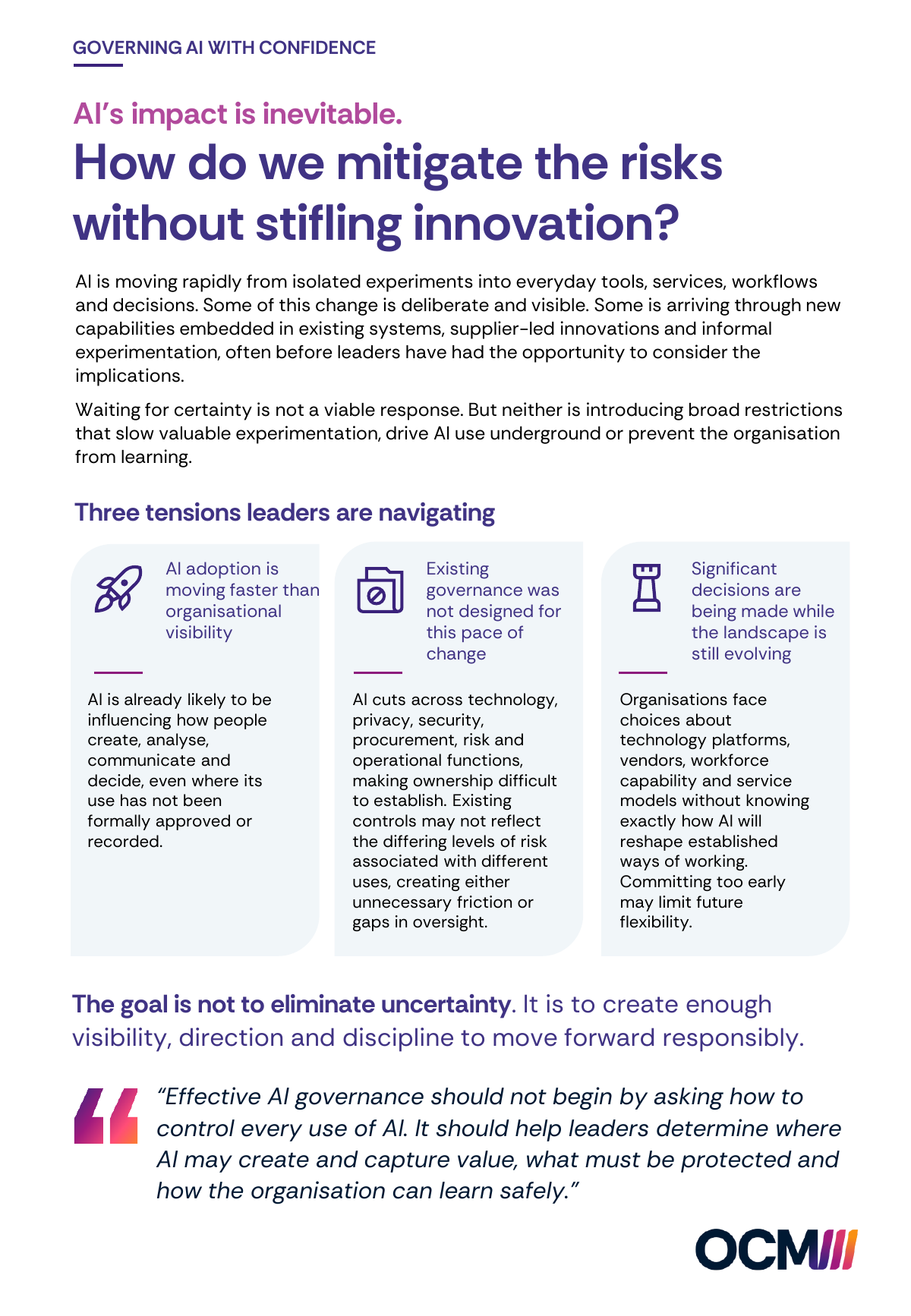
AI adoption is moving faster than organisational visibility.
AI may already be influencing how people work and decide, even where its use has not been formally approved or recorded. Organisations cannot govern what they cannot see.
Governing AI with confidence
AI is moving rapidly from isolated experiments into everyday tools, services, workflows and decisions. Some of this change is deliberate and visible. Some is arriving through embedded capabilities, suppliers and informal experimentation before leaders have had the opportunity to consider the implications.
The challenge is not choosing between innovation and control.
It is creating governance that gives people clear boundaries, proportionate pathways and the confidence to move faster with AI while protecting what matters.
The leadership challenge
The goal is not to eliminate uncertainty. It is to create enough visibility, direction and discipline to move forward responsibly.
AI’s impact is inevitable
The question is no longer whether AI will affect the organisation. It is already changing how people create, analyse, communicate and make decisions. The challenge is enabling valuable experimentation while retaining enough control to protect what matters.
AI may already be influencing how people work and decide, even where its use has not been formally approved or recorded. Organisations cannot govern what they cannot see.
AI cuts across technology, privacy, security, procurement, data, risk and operational functions. Existing controls can create unnecessary friction for low-risk activity and insufficient oversight for higher-impact uses.
Choices about platforms, vendors, workforce capability and service models are being made before the future state is clear. Committing too early can reduce the organisation’s ability to adapt.
“Effective AI governance should not begin by asking how to control every use of AI. It should help leaders determine where AI may create and capture value, what must be protected and how the organisation can learn safely.”
Governance that gives innovation room to move
It establishes clear boundaries where they are needed, enables proportionate experimentation and helps the organisation respond as technology, evidence and expectations change.
Low visibility, unclear accountability and accumulating risk.
Clear pathways, proportionate controls and visible accountability.
Every use treated as high risk, slowing learning and adoption.
See where AI is already changing the organisation, where it could create value and which opportunities and risks genuinely require leadership attention.
Establish accountabilities, decision rights and guardrails. Apply stronger controls where potential consequences are significant while lower-risk experimentation proceeds within clear boundaries.
Take no-regret actions, test assumptions, monitor material developments and preserve flexibility while evidence, technology and expectations continue to evolve.
Different AI needs different governance
Treating every AI use identically either creates unnecessary friction or leaves material risks insufficiently controlled. Good governance establishes proportionate pathways.
Drafting, summarisation, ideation and administrative assistance within approved environments.
AI materially informs a business or operational decision while a person remains responsible for the outcome.
AI influences or automates decisions with material consequences for people, services, finances, safety or organisational obligations.
As potential consequence, autonomy and uncertainty increase, governance should become stronger and more explicit.
From policy to practice
A policy can establish principles and expectations. Operational governance needs to answer the questions people encounter when they actually try to use AI.
Governance becomes useful when people can apply it to real situations without having to interpret an abstract framework every time.
Which tools, environments and information can be used without additional approval?
What characteristics trigger privacy, security, data, procurement, legal, ethical or operational review?
Who owns the opportunity, accepts the risks and has authority to approve deployment?
Can AI assist, recommend, decide or execute?
What needs to be understood about data handling, model behaviour, supplier dependencies and technology changes?
Who monitors performance, emerging risks, incidents and whether the AI is still creating the intended value?
Create a safe place to experiment
Many valuable AI opportunities start with a simple question: Could AI help us do this better?
Organisations need a way to explore those questions without creating unmanaged risk or forcing every early experiment through a heavyweight approval process.
Good governance should make it easier to know “yes, you can”, what conditions apply and when more scrutiny is needed.
People know where experimentation is permitted and which technologies have already been considered.
Teams understand what information may and may not be used.
Meaningful AI use can be identified without unnecessary administrative overhead.
People recognise when an experiment needs additional expertise or approval.
Teams know who to involve when privacy, security, data, procurement or operational concerns emerge.
Promising experiments have a clear route into assessment, deployment and ongoing governance.
From experimentation to enterprise
Governance cannot begin at the final approval meeting and end when an AI system goes live. Models, vendors, data, capabilities and operating conditions change.
What opportunity or problem are we trying to address?
What value could AI create and what are the potential consequences?
What data, environment, controls, capability and responsibilities are required?
Is the use ready to proceed and who accepts accountability?
How is AI introduced safely into the operating environment?
Is it behaving as expected and producing the intended value?
Have the technology, risks, assumptions or operating environment changed?
Make accountability visible
A use case may involve a model provided by one vendor, data owned by another team, a platform managed elsewhere and a decision made by someone who had no role in building the technology.
Good governance makes those responsibilities explicit.
The more AI can do, the clearer its boundaries need to become
Generative AI largely helped people create, analyse and interpret information. Agentic AI can increasingly take action.
Before allowing an AI agent to act, the organisation needs to define its desired outcome, authority, data and system access, rules, constraints, uncertainty thresholds, escalation points and monitoring.
An AI agent cannot safely operate inside an environment where the organisation has never clearly defined its authority and boundaries.
Governance should enable innovation at scale
Good governance should help the organisation identify, test, adopt and scale valuable uses of AI with greater confidence.
Leaders understand where material AI activity is occurring and where attention is required.
People know who may experiment, approve, deploy, operate and retire AI systems.
Lower-risk uses can progress quickly while higher-impact uses receive appropriate scrutiny.
Teams understand what information AI can access, how it may be used and where it can go.
Rules, constraints, prohibited uses and escalation points are explicit.
AI can support or automate activity without obscuring who remains responsible.
Governance continues after deployment as models, vendors, data and risks change.
The organisation can test ideas, observe outcomes and adapt its governance as evidence grows.
That is what allows experimentation to become sustainable innovation.
Questions worth discussing
01Where is AI already changing your organisation, whether formally or informally?
02Which opportunities and risks require leadership attention now?
03Are your current accountabilities and controls clear and proportionate?
04Where could premature decisions restrict your ability to adapt?
05How can you enable responsible experimentation and learn from it?
06Could you clearly define an AI agent’s objectives, authority, boundaries and escalation points before allowing it to act?
Start with an AI Organisational Impact Scan
The first step is not to build another governance framework. It is to understand how AI could affect the organisation, where it is already creating change and which opportunities, risks and decisions deserve leadership attention.
OCM’s AI Organisational Impact Scan provides a rapid, board-level view of how AI could affect your organisation, the opportunities and risks that matter most, and where leadership should focus next.
What the Scan provides
Prefer the concise read?
The two-page OCM paper summarises the leadership tensions created by rapid AI adoption and the three moves that help organisations create enough visibility, direction and discipline to innovate responsibly.
AI Governance